
Acrylite GP®
ACRYLITE® GP is a cell-cast acrylic sheet made to exacting standards. It offers excellent optical characteristics, thickness tolerances, light stability, and low internal stress levels for consistent performance. Colorless ACRYLITE GP acrylic sheet carries an exclusive 10-year limited warranty on light transmission, your assurance of a quality product. A printed copy of the warranty is available upon request. In addition to colorless sheet, a wide range of transparent and translucent colors is available.
Characteristics
ACRYLITE GP acrylic sheet is a lightweight, rigid thermoplastic material that has many times the breakage resistance of standard window-pane glass. It is highly resistant to weather conditions. ACRYLITE GP sheets can be easily sawed, machined, thermoformed, and cemented. It is suitable for most commercial applications, and is ultraviolet light absorbing.
For greater ultraviolet light transmission, ACRYLITE OP-1 or ACRYLITE OP- acrylic sheet may be used. For greater ultraviolet absorption, ACRYLITE OP-2 sheet filters out more of the UV radiation than regular ACRYLITE GP sheet grades.
For greater impact, ACRYLITE GP-1.25″ (bullet resistant) sheet may be used.
Because of its unique properties, ACRYLITE GP acrylic sheet is ideal for a wide range of applications such as:
| • Merchandising Displays • Lighting Fixture Diffusers • Decorative Paneling |
• Security Glazing • Aquariums • Hockey Rinks |
• Industrial and School Glazing • Shower Enclosures • Skylights • Signs |
Safety
ACRYLITE GP sheet meets the requirements of ANSI Z 97.1 for use as a Safety Glazing material in Buildings for thickness equal to or greater than 0.080″ (2.0mm). ACRYLITE GP sheet is more impact-resistant than glass. If subjected to impact beyond the limit of its resistance, it does not shatter into small slivers but breaks into comparatively large pieces.
Weather Resistance
Acrylic offers better weather resistance than other types of plastics used for transparent sheets. ACRYLITE GP sheet will withstand exposure to blazing sun, extreme cold, sudden temperature changes, salt water spray and other harsh conditions. It will not deteriorate after many years of service because of the inherent stability of acrylic. ACRYLITE GP sheet has been widely accepted for use in skylights, school buildings, industrial plants, aircraft glazing and outdoor signs.
Dimensional Stability
Although ACRYLITE GP acrylic sheet will expand and contract due to changes in temperature and humidity, it will not shrink with age. Some shrinkage occurs when ACRYLITE GP sheet is heated to forming temperature.
Light Weight
ACRYLITE GP sheet is less than half the weight of glass, and 3% the eight of aluminum. One square foot of 1/8″ (3.0mm) thick ACRYLITE GP sheet weighs less than 3/ pound (1/3 kilogram).
Rigidity
ACRYLITE GP sheet is not as rigid as glass or metals. However, it is more rigid than many other plastics such as acetates, polycarbonates, or vinyls. Under wind load, a sheet will bow and foreshorten as a result of deflection. For glazing installation, the maximum wind load and the size of the window must be considered when the thickness of the panel and the depth and width of the rabbet are to be determined. If ACRYLITE GP sheet is formed into corrugated or domed shapes, rigidity is increased and deflection minimized.
Cold Flow
If not sufficiently supported, large, flat ACRYLITE GP sheets may deform to continuous loads such as snow, or even from their own weight. Increased rigidity obtained by forming will minimize cold flow.
Strength and Stresses
Although the tensile strength of ACRYLITE GP acrylic sheet is 10,000 psi (69 MPa) at room temperature (ASTM D638), stress crazing can be caused by continuous loads below this value. For most applications, continuously imposed design loads should not exceed 1,500 psi (10. MPa).
Localized, concentrated stresses must be avoided. For this reason, and because of thermal expansion and contraction, large sheets should never be fastened with bolts, but should always be installed in frames. All thermoplastic materials–including ACRYLITE GP sheet–will gradually lose tensile strength as the temperature approaches the maximum recommended for continuous service. For ACRYLITE GP sheet, the maximum is 180ºF (82ºC).
Expansion and Contraction
Like most other plastics, ACRYLITE GP sheet will expand 3 times as much as metals, and 8 times as much as glass. The designer should be aware of this rather large coefficient of expansion. A 8″ panel will expand and contract approximately 0.002″ for each degree F change in temperature. In outdoor use, where summer and winter temperatures differ as much as 100ºF, a 8″ sheet will expand and contract approximately 3/16″. Sash rabbets must be of sufficient depth to allow for expansion as well as for contraction.
ACRYLITE GP sheet also absorbs water when exposed to high relative humidities, resulting in expansion of the sheet. At relative humidities of , 80%, and 60%, the dimensional changes are 0. , 0. % and 0.2%, respectively.
Heat Resistance
ACRYLITE GP sheets can be used at temperatures from – 0ºF (- 0ºC) up to 200ºF ( 93ºC), depending on the application. It is recommended that temperatures not exceed 180ºF for continuous service, or 200ºF for short, intermittent use. Components made of ACRYLITE GP sheet should not be exposed to high heat sources such as high wattage incandescent lamps, unless the finished product is ventilated to permit the dissipation of heat.
Light Transmission
Clear, colorless ACRYLITE GP acrylic sheet has a light transmittance 92%. It is warranted not to lose more than 3% of its light-transmitting ability in a 10-year period. ACRYLITE OP-1 sheet and ACRYLITE OP- sheet (ultraviolet transmitting) transmit more ultraviolet light in the range from 2 0 to 380 nanometers than regular ACRYLITE GP sheet grades. ACRYLITE OP-2 sheet (ultraviolet filtering) absorbs more radiation in the ultraviolet range below 00 nanometers than regular ACRYLITE GP sheet grades. It is used to protect art objects and documents from the damaging effects of ultraviolet light.
Solar Energy Control
Transparent, colored ACRYLITE GP sheets can be used to reduce glare and solar energy transmittance. The sheets are available in a wide range of color densities with light transmittance values from to 79%. This broad selection enables the designer to choose a density which will provide adequate daylight and, at the same time, control glare and solar heat buildup.
Light Diffusion
Translucent white and translucent colored ACRYLITE GP sheets diffuse light. Colorless, textured sheets also diffuse light to some extent. Translucent white ACRYLITE GP acrylic sheet is available in 5 standard densities and several thicknesses varying in light transmittance from 11% to 67%.
Chemical Resistance
ACRYLITE GP acrylic sheet has excellent resistance to many chemicals including:
• Solutions of inorganic alkalies such as ammonia
• Dilute acids such as sulfuric acid
• Aliphatic hydrocarbons such as hexane
ACRYLITE GP sheet is not attacked by most foods, and foods are not affected by it.
It is attacked, in varying degrees, by:
• Aromatic solvents such as benzene and toluene
• Chlorinated hydrocarbons such as methylene chloride and carbon tetrachloride
• Ethyl and methyl alcohols
• Some organic acids such as acetic acid
• Lacquer thinners, esters, ketones and others
Formability
ACRYLITE GP sheet will soften gradually as temperature is increased above 210ºF (99ºC). At temperatures from 3 0ºF to 380ºF (171ºC to 193ºC), it becomes soft and pliable and can be formed into almost any shape using inexpensive molds. The optimum forming temperature within this range depends on thickness and desired depth of draw. ACRYLITE GP sheet will typically shrink 1.5% when heated without a frame. As the sheet cools, it will harden and retain the formed shape. Because ACRYLITE GP sheet is a thermoplastic material, heating a formed part to temperatures above 210ºF (99ºC) will cause it to revert to its original flat condition.
Cutting and Machining
ACRYLITE GP sheet can be sawed with circular saws or band saws. It can be drilled, routed, filed and machine much like wood or brass. Cooling of the cutting tool is recommended to keep the machined edge of the sheet as cool and stress free as possible. Heat buildup should be avoided because it could lead to stress crazing. Tool sharpens and “trueness” are also essential to prevent gumming, heat buildup and stresses in the part.
Laser Cutting
Laser technology is being rapidly accepted by industry for quickly and accurately cutting, welding, drilling, scribing, and engraving plastics.
CO2 lasers focus a large amount of light energy on a very small area which is extremely effective for cutting complex shapes in acrylic sheet. The laser beam produces a narrow kerf in the plastic allowing for close nesting of parts and minimal waste. CO2 lasers vaporize the acrylic as they advance resulting in a clean polished edge but with high stress levels; annealing acrylic sheet after laser cutting is recommended to minimize the chance of crazing during the service life of the part.
Cementing
ACRYLITE GP sheet can be cemented using common solvent cements or polymerizable cements. The most critical factor is the edge of the part to be cemented. The edge must have been properly machined so as to have a square flat surface and no stresses. Annealing of the part prior to cementing is recommended. Cement and cement fumes should not contact formed or polished surfaces.
Annealing
To eliminate stresses caused by machining and/or polishing, annealing is recommended. ACRYLITE GP sheet may be annealed at 180ºF (82ºC) with the heating and cooling times determined by the sheet thickness. An approximate guideline is: annealing time in hours equals the sheet thickness in millimeters and the cool-down period equals the sheet thickness in millimeters. For example, 3mm (1/8″) ACRYLITE GP sheet would be heated for 3 hours at 180ºF and slowly cooled for 3 hours.
Flammability
ACRYLITE GP sheet is a combustible thermoplastic. Precautions should be taken to protect the material from flames and high heat sources. Acrylite GP acrylic sheet usually burns rapidly to completion if not extinguished. The products of combustion, if sufficient air is present, are carbon dioxide and water. However, in many fires sufficient air will not be available and toxic carbon monoxide will be formed, as it is from other combustible materials. We urge good judgment in the use of this versatile material and recommend that building codes be followed carefully to ensure it is used properly.
Other properties related to flammability:
• Burning rate is .6cm per minute (for 2 mm thickness) according to ASTM D 635
• Flame spread is 1 0 (for 3 mm thickness) according to ASTM E 8 , or 110-1 0 (for 3 mm-6 mm thickness) according to CAN- -S102.2.
• Smoke density: Measured by ASTM D 28 3 is 10.3%
• Self-ignition temperature is 910ºF ( 88ºC) (for 1.5 mm thickness) when measured in accordance with ASTM D 1929
While these test data are based on small scale laboratory tests frequently referenced in various building codes, they do not duplicate actual fire conditions.
Acrylite GP sheet meets the requirements of the following building codes for use as a Light Transmitting Plastic:
— BOCA (See BOCA Evaluation Services, Inc., Research Report #9 -30)
— ICBO (See ICBO Evaluation Services, Inc., Evaluation Report #2158-CC2 Classification)
— SBCCI (Refer to #SBCCI PST & ESI Evaluation Report #93122 for Code compliance)
Thermal Conductivity
The thermal conductivity of a material –its ability to conduct heat–is called k-Factor. The k-Factor is an inherent property of material, and is independent of its thickness and of the surroundings to which it is exposed.
The k-Factor of ACRYLITE GP sheet is 1.3 B.T.U./(hour)(sq. ft.)(ºF./inch) or 0.19W/M.K.
Whereas the k-Factor is a physical property of the material, the U-Factor –or overall coefficient of heat transmission–is the value used to calculate the total heat loss or gain through a window. The U-Factor is the amount of heat, per unit time and area, which will pass through a specific thickness and configuration of material per degree of temperature difference on each of the two sides.
This value takes into account the thickness of the sheet, whether the sheet is in a horizontal or vertical position, as well as the wind velocity. U-Factors are based on specific conditions (e.g., single-glazed or double-glazed installations) and are different for summer or winter.
Listed below are U-Factors for several thicknesses of ACRYLITE GP sheet for single-glazed, vertical installations, based on the standard ASHRAE* summer and winter design conditions.
|
U-Factors–BTU/hour sq.ft. Fº (w/m² * K)
|
|||
|
ACRYLITE |
Summer Conditions | Winter Conditions | |
| mm | inches | ||
| 3.0 | .118 | 0.98 (5.56) | 1.06 (6.02) |
| .5 | .177 | 0.9 (5.3 ) | 1.02 (5.79) |
| 6.0 | .236 | 0.90 (5.11) | 0.97 (5.51) |
| 9.0 | .35 | 0.83 ( .71) | 0.89 (5.05) |
| 31.5 | 1.25 | 0.56 (3.18) | 0.58 (3.29) |
The total heat loss or gain through a window (due to temperature difference only) can be calculated by multiplying the area of the window, times the difference between indoor and outdoor temperatures, times the appropriate U-Factor (from Table above). Heat intake through solar radiation must be added to arrive at the total heat gain. ACRYLITE GP sheet is a better insulator than glass. Its U-Factor or heat transfer value is approximately 10% lower than that of glass of the same thickness. Conversely, its RT-Factor is about 10% greater.
Thermal Shock and Stresses
ACRYLITE GP sheet is more resistant than glass to thermal shock and to stresses caused by substantial temperature differences between a sunlit and a shaded area of a window or between opposite surfaces of a window.
Surface Hardness
The surface of plastics is not as hard as that of glass. Therefore, reasonable care should be exercised in handling and cleaning ACRYLITE GP sheet.
Electrical Properties
ACRYLITE GP sheet has many desirable electrical properties and continuous outdoor exposure has little effect on these properties. It is a good insulator with surface resistivity higher than that of most plastics.
|
Physical Properties
of ACRYLITE GP |
||||||||||||||||||||||||||||||||
| Property(a) |
ASTM Method |
Typical Value |
||||||||||||||||||||||||||||||
| Mechanical |
|
|||||||||||||||||||||||||||||||
|
Optical |
|
|||||||||||||||||||||||||||||||
| Thermal |
|
|||||||||||||||||||||||||||||||
| Electrical |
|
|||||||||||||||||||||||||||||||
|
Water |
D 570 |
0.2% 0.2% 0.0% 0.2% 0.2% |
||||||||||||||||||||||||||||||
| Long Term Water Absorption | D 570 |
0.5% 0. 0.8% 1.0% 1.1% |
||||||||||||||||||||||||||||||
| Odor | — | None | ||||||||||||||||||||||||||||||
| Taste | — | None | ||||||||||||||||||||||||||||||

Full-service plastics fabricator and supplier of plastic materials










Norva Plastics has been a full-service plastics fabricator and supplier of plastic materials. With over half a century in the business, we can tackle just about any job with confidence that comes from experience. From a tough prototype to long-run production, whatever your requirement, contact the experienced plastics fabricators first at Norva Plastics.
Norva Plastics provides many services relating to plastics and similar materials. We have 3 high precision CNC machines in house to handle high production jobs or for quick prototype jobs. We also do custom fabrication and also offer vacuum forming services. So contact us now! We look forward to serving you.
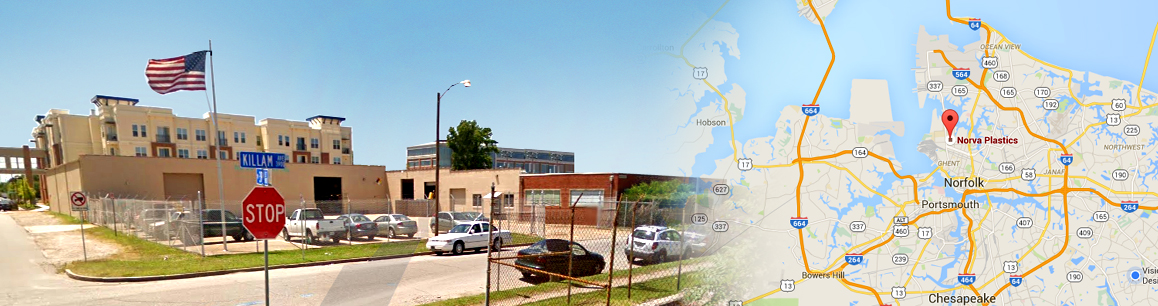
Norva Plastics • 3911 Killam Ave., Norfolk, Virginia 23508
Open 8:00AM to 4:30PM Monday through Friday
Toll Free: 1(800) 826-0758 • Ph: (757) 622-9281 • Fax: (757) 623-2859 • Email: info@norvaplastics.com
