
Acrylite PLUS®
Continuously manufactured ACRYLITE PLUS® acrylic sheet is a versatile, thermoplastic material developed for the retail display and glazing markets as well as other markets requiring strength, appearance and weatherability. High optical quality ACRYLITE PLUS sheet provides the beautiful look of acrylic with much greater impact strength for durability during manufacturing, shipping, and in-store use. Rigid, tough, and lightweight, ACRYLITE PLUS sheet is easily fabricated and machined, including cutting, routing, forming, and cementing.
ACRYLITE PLUS sheet is ideal for use in:
• P-O-P Displays
• Store Fixtures
• Glazing
• General Fabrication
Availability
ACRYLITE PLUS sheet is available in colorless and glass green. It is manufactured in standard sheet size 48″ x 96″. Colorless sheet is available in thicknesses of 1.5 mm (0.060″) to 6.0 mm (0.236″); glass green is available in thicknesses of 2.0 mm (0.080″) to 6.0 mm (0.236″). Custom sizes are available on request. All sheets are protected with 3 mil thick polyethylene film masking.
Impact Strength
Superior performance ACRYLITE PLUS sheet has many times the impact strength of glass and standard acrylic sheet. (Testing per ASTM D 3029).
Light Weight
ACRYLITE PLUS sheet weighs half as much as glass.
Surface Hardness
With a greater surface hardness than polyesters, ACRYLITE PLUS sheet helps to reduce damage during fabrication and extends service life.
Dimensional Stability
ACRYLITE PLUS sheet will expand or contract when exposed to temperature or humidity change. The material’s post-forming stability is excellent, however, shrinkage will occur when an unclamped sheet is subjected to forming temperatures.
Strength and Stresses
The tensile strength of ACRYLITE PLUS sheet is 8,900 psi at room temperature (ASTM D 638). For applications subject to continuous loadings, the design should allow for a load that will not exceed 600 psi at 23°C (73°F). Continuous loads well below 8,900 psi will lead to stress crazing and eventual failure.
Heat Resistance
ACRYLITE PLUS sheet keeps its rigid shape up to 160°F. When subjected to temperatures below 32°F and higher than 100°F, ACRYLITE PLUS sheet begins to appear hazy. Once the sheet equalizes (between 60-80°F) it returns to its original, high light transmitting clarity.
Light Transmission
Colorless ACRYLITE PLUS sheet’s light transmittance is greater than 91% (1/8″ thickness). It retains high light transmitting properties for many years.
Formability
ACRYLITE PLUS sheets’ forming temperature range is 270°F -350°F. ACRYLITE PLUS sheet softens with temperature increases above °F, thus passing through the thermo elastic to the thermoplastic state. This change is gradual, rather than sharply defined. Because this change is gradual, certain procedures should be considered during thermoforming. If the sheet is to be hung in an oven, a continuous clamp rather than several individual clamps must be used, preventing permanent deformation of the sheet between clamps. If the sheet is heated by infrared heaters supported in a horizontal frame, control of the heaters positioned over the center of the sheet will prevent over heating the center of the sheet, which could cause an excessive amount of sagging. Shrinkage occurs in the machine direction when heating is performed without clamping. The shrinkage range is 3-5%, depending on thickness and forming temperature. Expansion can be expected in the cross machine direction. This will range from 0-2.2%, again depending on thickness and forming temperature.
Chemical Resistance
ACRYLITE PLUS sheet resists many chemicals, some of which include:
• Solutions of inorganic alkalies
• Diluted acids
• Aliphatic hydrocarbons
It is attacked, in varying degrees by, but not limited to:
• Aromatic solvents (i.e. benzene and toluene)
• Alcohols
• Chlorinated hydrocarbons (i.e. methylene chloride)
• Lacquer thinners (esters, ketones and ethers)
ACRYLITE PLUS sheet meets FDA requirements for use in many food contact applications.
Cutting and Machining
ACRYLITE PLUS sheet is cut and shaped using all of the same machining operations used with standard acrylic sheet. (i.e. cutting, routing, drilling, etc.)
Laser Cutting
Laser technology is being rapidly accepted by industry for quickly and accurately cutting, welding, drilling, scribing, and engraving plastics. CO2 lasers focus a large amount of light energy on a very small area which is extremely effective for cutting complex shapes in acrylic sheet. The laser beam produces a narrow kerf in the plastic allowing for close nesting of parts and minimal waste. CO2 lasers vaporize the acrylic as they advance resulting in a clean polished edge but with high stress levels; annealing acrylic sheet after laser cutting is recommended to minimize the chance of crazing during the service life of the part.
Cementing
Common solvent cements or polymerizable cements work well when joining ACRYLITE PLUS sheet to itself or other acrylic sheet products. Care must be taken to provide a sheet edge that is machined properly and contains low stress. A generous amount of cement should be applied along the entire length of pieces being joined, taking care to ensure the cement fills the entire area between the pieces. Pleas refer to the “ACRYLITE PLUS Sheet Fabrication Manual” for detailed information.
Annealing
ACRYLITE PLUS sheet may be annealed at 180°F with the heating and cooling times dependent on sheet thickness. An approximate guideline is: annealing time in hours is equal to the sheet thickness in millimeters (to a minimum of 2 hrs); the cool down period should be a minimum of 2 hours, ending when sheet temperature falls below 140°F.
Weather Resistance
ACRYLITE PLUS sheet is manufactured from a weatherable acrylic polymer. It can be used outdoors for many years with little loss of impact strength or its acrylic-like appearance.
Flammability
ACRYLITE PLUS sheet is a combustible thermoplastic. Precautions should be taken to protect this material from flames and high heat sources. ACRYLITE PLUS sheet usually burns rapidly to completion if not extinguished. The products of combustion, if sufficient air is present, are carbon dioxide and water. However, in many fires, sufficient air will not be available and toxic carbon monoxide will be formed, as it will when other common combustible materials are burned. We urge good judgment in the use of this versatile material and recommend that building codes be followed carefully to assure it is used properly.
Physical Properties of ACRYLITE Plus
| Property(a) | ASTM Method |
Typical Value (.236″ Thickness)(b) |
|||||||||||||||||||||||||
| Mechanical |
|
||||||||||||||||||||||||||
|
Optical (Clear Material) |
|
||||||||||||||||||||||||||
| Thermal |
|
||||||||||||||||||||||||||
|
Water Absorption |
24 hrs @ 73ºF | D 0 | 0.3% | ||||||||||||||||||||||||
Chemical Stability
This data was realized at test temperature 68°F. (20°C) and 50% relative humidity. Results vary depending on the temperature and moisture content of the materials. In practice, resistance is dependant on internal and external stresses as well as the method of fabrication. We recommend appropriate testing.
Chemical Resistance
The table below gives an indication of the chemical resistance of ACRYLITE FF. The code used to describe chemical resistance is as follows–
R=Resistant
ACRYLITE FF withstands this substance for long periods and at temperatures up to 120°F(49°C).
LR=Limited Resistance
ACRYLITE FF only resists the action of this substance for short periods at room temperatures. The resistance for a particular application must be determined.
N=Not Resistant
ACRYLITE FF is not resistant to this substance. It is either swelled, attacked, dissolved or damaged in some manner.
ACRYLITE PLUS sheet resists most chemicals in normal use with resistance to fatty and oily products. There is no measurable permeation or adverse effect on the material in contact with oils and aliphatic hydrocarbon-based products.
| Chemical | Code | Chemical | Code |
| Beer, wine, fruit juices | R | Coffee, tea | R |
| Cooking oil | LR | Liqueurs, see ethyl alcohol | LR |
| Milk, chocolate | R | Vinegar | R |
| Water, mineral water | R | Aniseed, bay leaves, nutmeg | R |
| Cloves | N | Pepper, cinnamon, onions | R |
| Animal oil/grease | R | Mineral oil | R |
| Vegetable oil | R | Acrylic paints | LR |
| Cellulose paints | N | Paint thinners | N |
| Pure-oil points | R | Wax polish | LR |
| Ammonia gas | R | Bromine gas | LR |
| Carbon dioxide gas | R | Chlorine gas | LR |
| Methane gas | R | Natural gas | R |
| Nitrogen dioxide | R | Nitrogen monoxide | R |
| Sulfur dioxide (dry) | N | Caustic potash | R |
| Soap suds | R | Soda | R |
| Whitewash | R | Bleaching powder paste | R |
| Bleaching powder solution up to 20% | R | Carbolic acid | N |
| Hydrogen peroxide, up to 40% | R | Tincture of iodine, 5% | N |
| Chromic acid | LR | Calcium hypo chlorite | R |
| Hydrochloric acid | N | Hydrofluoric acid, up to 20% | LR |
| Nitric acid, up to 20% | R | Nitric acid, 20 to 70% | LR |
| Phosphoric acid, up to 20% | R | Sulfuric acid, up to 30% | R |
| Sulfurous acid, concentrated | LR | Sulfurous acid, up to 5% | R |
| Sulfur dioxide, liquid | N | Acetone | N |
| Amyl acetate | N | Aniline | N |
| Benzaldehyde | N | Benzene | N |
| Butanol | N | Carbon disulfide | N |
| Chlorinated hydrocarbons | N | Chlorophenol | N |
| Cresol | N | Cyclohexane | LR |
| Diacetone alcohol | N | Dibutyl phthalate | N |
| Diethylene glycol | R | Dioxane | N |
| Ether | N | Ethyl acetate | N |
| Ethyl alcohol, up to 30% | LR | Ethyl alcohol over 30% | N |
| Ethyl bromide | N | Ethyl butyrate | N |
| Ethylene bromide | N | Ethylene glycol | LR |
| Heptane | R | Hexane | R |
| Isopropyl alcohol | LR | Lactic acid butyl ester | N |
| Nethyl ethyl ketone | N | Methanol, up to 30% | LR |
| Methanol, over 30% | N | Methyl chloride | N |
| Motor fuel mixture, with benzene | N | Motor fuel mixture, without benzene | LR |
| Paraffin | LR | Perchlorethylene | LR |
| Phenols | N | Pryidine | N |
| Tricresyl phosphate | R | Triethyl amine | R |
| Toluene | N | Xylene | N |
| Photographic baths | R | Nail polish | N |

Full-service plastics fabricator and supplier of plastic materials










Norva Plastics has been a full-service plastics fabricator and supplier of plastic materials. With over half a century in the business, we can tackle just about any job with confidence that comes from experience. From a tough prototype to long-run production, whatever your requirement, contact the experienced plastics fabricators first at Norva Plastics.
Norva Plastics provides many services relating to plastics and similar materials. We have 3 high precision CNC machines in house to handle high production jobs or for quick prototype jobs. We also do custom fabrication and also offer vacuum forming services. So contact us now! We look forward to serving you.
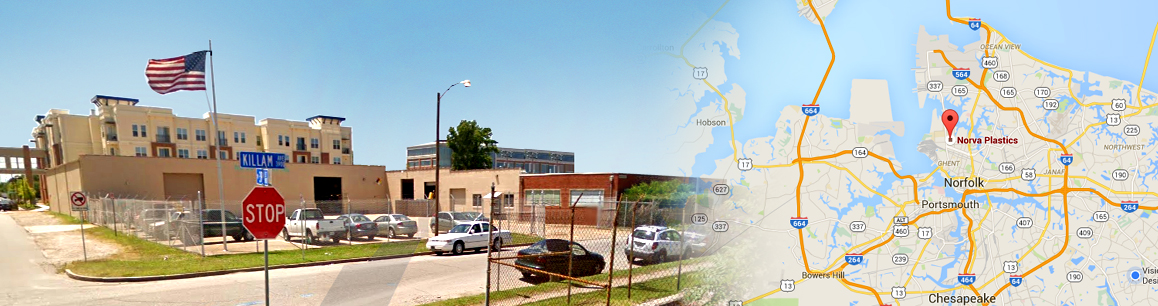
Norva Plastics • 3911 Killam Ave., Norfolk, Virginia 23508
Open 8:00AM to 4:30PM Monday through Friday
Toll Free: 1(800) 826-0758 • Ph: (757) 622-9281 • Fax: (757) 623-2859 • Email: info@norvaplastics.com
