
Phenolic Selection Chart
|
Construction
Reinforcement Resin |
Applications | Features |
Military Specs
and Type |
Nema Grade
|
Grade
|
Color
|
|---|---|---|---|---|---|---|
|
Paper Phenolic
|
Mechanical grade, intricate punch parts, insulating washers, switch bases, terminal boards |
Requires little to no preheating, good warm shearing, warm punch, U.L. listed, File #E141228 |
MIL-I-24768/19 PBM-P
|
XP XP XP |
H-27095 H-27096 H-27102 |
Natural Black Chocolate |
| Mechanical grade, intricate punch parts | Excellent cold punch cold shearing |
MIL-I-24768/20 PBM-PC
|
XPC XPC |
H-18332 H-18333 |
Tan Black |
|
| Mechanical grade, Jigs, templates | Non Nema. Economy Grade |
N/A
|
N/A
|
H-27028
|
Natural
|
|
| Electrical grade – tap changer boards, transformers | Low 60 cycle power – factor, low cold flow, dielectric constant |
H-18720
|
Natural
|
|||
| Electrical grade, switch board panels, relay and switch bases, breaker arms, barriers |
Electrical insulation in dry or humid conditions, good machining, fair mechanical strength |
LP-5130C PBG MIL-I-24768/11 PBG
|
XX XX |
219 429 |
Natural Black |
|
| Electrical grade, punch parts, radio and TV terminal boards, panels |
Cold punch and shearing, high insulation resistance and low dielectric losses under severe humidity. U.L. listed as HO3 |
LP-513-C PBEP MIL-I-24768/23 PBE-PC
|
XXXPC
|
H-5639
|
Natural
|
|
|
Fine
Weave Cotton Cloth Phenolic |
Intricate machine grade low surface wear – bearings | Linen with PTFE – high limiting pressure velocity (PV) low surface wear |
H-27126
|
Natural
|
||
| Electrical-mechanical grade, marine relay bases, terminal bases and strips, radio parts, high humidity applications |
Electrical and mechanical strength, moisture resistance |
MIL-I-24768/13 FBE
|
LE
|
H-27024 H-27027 |
Natural Black |
|
| Mechanical grade – for fine machined parts, gears, radio parts, terminal boards |
Fine weave canvas where better than CE machining characteristics are required and grade L cannot be justified |
H-25126
|
Natural
|
|||
|
Medium
Weave Cotton Cloth Phenolic |
Mechanical grade – gears, pinions, spacers, structural applications |
Economy grade, high impact strength, good mechanical properties |
MIL-I-24768/16 FBM
|
C C |
H-26000 H-25045 |
Natural Black |
| Mechanical-electrical grade, small gears, pinions, radio parts, marine switch board panels |
Economy grade, good acid resistance, low voltage, low frequency electrical performance |
MIL-I-24768/14 FBG
|
CE CE |
51F33 H-27108 |
Natural Black |
|
| Mechanical grade, marine bearings, pistons and packing rings, pump valve, doctor blades, marine Micarta® |
Low moisture absorption, dimensional stability |
MIL-P-18324
|
223
|
Natural
|
||
| Mechanical grade, packing rings, pistons, bearings, electrical applications |
Canvas with molybdenum disulfide, low coefficient of friction |
H-13020
|
Green
|
|||
| Mechanical grade, pistons, packing rings, textile mill bearings |
Canvas with graphite, self-lubricating, low coefficient of friction |
MIL-P-5431-A-AS
|
400
|
Black
|
||
| Mechanical grade, pistons, packing rings, textile mill bearings, non-electrical applications |
Canvas with graphite, self-lubricating, low coefficient of friction |
H-24889
|
Black
|
|||
|
Glass
Phenolic |
Structural applications, seals, gaskets-resist acids | Excellent strength, excellent heat resistance, high impact, low moisture |
MIL-I-24768/18 GPG
|
G-3
|
H-19989
|
Natural
|
|
Glass
Melamine |
Electrical-mechanical grade, marine switch board panels, structural parts |
High mechanical strength, high arc and heat resistance, self-extinguishing, excellent electrical properties under dry and humid conditions |
MIL-I-24768/1 GME
|
H-12426
|
Gray
|
|
|
Glass
Silicone |
Electrical grade, class H insulation, heating applications insulation |
Good electrical properties under humid conditions, excellent heat and arc resistance, self-extinguishing |
MIL-I-24768/17 GSG
|
G-7 N/A |
H-17825 H-25219 |
White White |
|
Glass
Epoxy |
Electrical-mechanical grade, terminal boards, high humidity applications |
High flexural, impact and bond strength at room temperatures, good electrical properties under dry and humid conditions, U.L. 94V-O |
MIL-I-24768/27 GEE-F
|
FR-4
|
H-22033 H-26955 |
Natural Black |
| Electrical-mechanical grade, rotor, slot insulation, structural members at elevated temperatures |
High mechanical strength at temperatures up to 150°C, retains 50% of its flexural strength at elevated temperatures |
MIL-I-24768/3 GEB
|
G-11
|
H-26671
|
Natural
|
|
| Electrical-mechanical grade, high humidity applications, power generation and transmission components |
High flexural, impact and bond strength at room temperatures, good electrical properties under dry and humid conditions, non-brominated resin system |
MIL-I-24768/2 GEE
|
G-10
|
H-27092
|
Natural
|
|
|
Static
Dissipative Glass Epoxy (Statnot TM) |
Static dissipative grades, protecting static-sensitive electronic applications such as: automated test equipment, assembly fixtures, solder pallets, carrier plates, enclosures, work surfaces |
High strength, printable surface, excellent dimensional stability, five times the stiffness of leading thermoplastics, eliminates cracking and chipping, uniform thickness of ESD, cost-effective. |
ESD Throughout
|
High Temp.
|
H-27210
|
Black
|
|
ESD One sided
|
FR-4 Core
|
H-27227
|
Black
|
|||
|
ESD Two sided
|
FR-4 Core
|
H-27228
|
Natural Black
|

Full-service plastics fabricator and supplier of plastic materials










Norva Plastics has been a full-service plastics fabricator and supplier of plastic materials. With over half a century in the business, we can tackle just about any job with confidence that comes from experience. From a tough prototype to long-run production, whatever your requirement, contact the experienced plastics fabricators first at Norva Plastics.
Norva Plastics provides many services relating to plastics and similar materials. We have 3 high precision CNC machines in house to handle high production jobs or for quick prototype jobs. We also do custom fabrication and also offer vacuum forming services. So contact us now! We look forward to serving you.
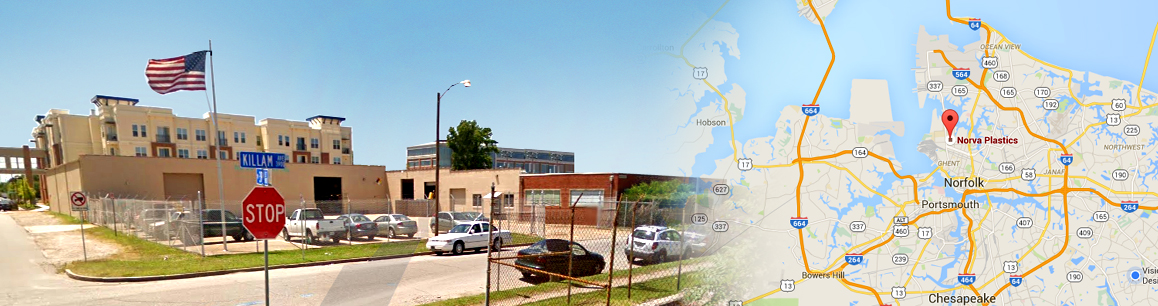
Norva Plastics • 3911 Killam Ave., Norfolk, Virginia 23508
Open 8:00AM to 4:30PM Monday through Friday
Toll Free: 1(800) 826-0758 • Ph: (757) 622-9281 • Fax: (757) 623-2859 • Email: info@norvaplastics.com
