
Teflon®
Teflon is a soft, waxy, opaque material that is nearly white in color. It is about 90% crystalline and has a molecular weight between 500,000 and 2,000,000. Teflon is polymerized from a monomer (a small molecule that combines with other monomers to yield a polymer called tetraflouroethylene), which is produced through a series of chemical reactions. Teflon is inert to all solvents and chemicals agents except molten alkali metals and hot fluorine gas. It is capable of stand continuous exposure to temperatures ranging from near zero, to where it begins to depolymerize above 600 °C (1112 °F). Because of its resistance of the strong C-F bonds to chemical attack, Teflon is an inert, tough, and nonflammable material widely used for electrical insulation.
Heat
Teflon retains its properties after exposure to temperatures beyond the limit of almost all other thermoplastics and elastomers. Depending on the end-use requirements, Teflon is rated for continuous service at temperatures as high as 500°F. It also can sustain short exposure at higher temperatures.
Flame Resistance
Teflon offers extraordinary resistance to high temperature and flames because it has a very high melting point and auto-ignition Temperature, as well as exceptional thermal degradation thresholds. Teflon’s flame propagation characteristics, such as rate of heat release and smoke generation is very low Friction and WearTeflon has one of the lowest coefficients of friction of any solid material. Its abrasions resistance is adaptable to demanding environments by using inorganic fillers, such as glass fiber, carbon or graphite.
Contamination
Teflon is chemically pure and inert. It contains no additives such as lubricants, stabilizers, plasticizers or antioxidants that can contaminate process luids.
Adhesion/Release
Teflon has an extremely low surface energy in the solid state. This provides an excellent anti-stick, non-wetting contact surface. Conversely, when these resins are in a molten form, they become low surface- tension liquids, ideal for hot melt adhesives.
Low Temperature Service
Teflon retains its excellent properties even at cryogenic temperatures. Teflon’s impact resistance at these temperatures exceeds that of most other polymers.
Corrosion
Teflon has excellent chemical resistance. It will resist most aggressive organic and inorganic chemicals, acids and solvents over a broad temperature range.
Service Life
Teflon exhibits excellent retention of properties after a long period of time, even at elevated temperatures and in the presence of oils, solvents, UV light, oxidizing agents and other environmental agents.
Light Stability
Teflon has one of the lowest refractive indexes. It does not change its visual appearance after exposure to ultraviolet or infrared light.
Dielectrics
Teflon has remarkable dielectric strength, low dielectric constant, low loss factors and high specific resistance. Teflon surpasses most material in its level and stability of dielectric properties over a wide range of environmental conditions.
Biodegradation
Teflon is inert to microbiological and enzymic attack because the pure polymer does not provide any nourishment or porosity for these growths.
Atmospheric Aging
Teflon is not affected by ultraviolet and is resistant to oxidation, discoloration, and embrittlement.
Humidity
Teflon is completely resistant to hydrolysis. Teflon is a good barrier for water permeation. Its typical properties and dimensional stability remain unchanged even after long periods of time in water.

Full-service plastics fabricator and supplier of plastic materials










Norva Plastics has been a full-service plastics fabricator and supplier of plastic materials. With over half a century in the business, we can tackle just about any job with confidence that comes from experience. From a tough prototype to long-run production, whatever your requirement, contact the experienced plastics fabricators first at Norva Plastics.
Norva Plastics provides many services relating to plastics and similar materials. We have 3 high precision CNC machines in house to handle high production jobs or for quick prototype jobs. We also do custom fabrication and also offer vacuum forming services. So contact us now! We look forward to serving you.
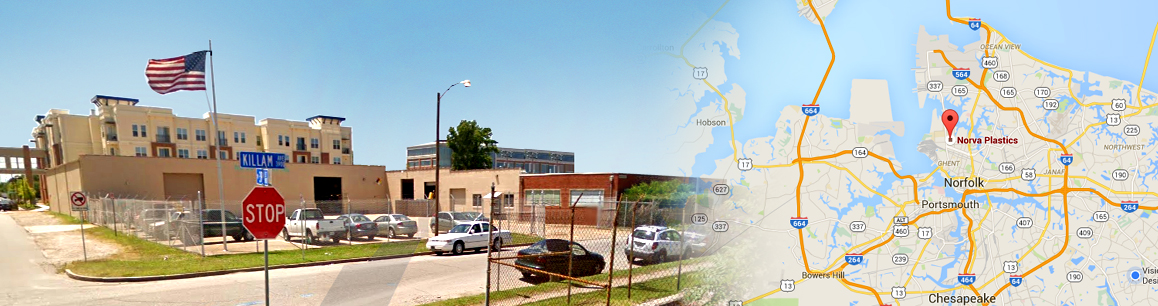
Norva Plastics • 3911 Killam Ave., Norfolk, Virginia 23508
Open 8:00AM to 4:30PM Monday through Friday
Toll Free: 1(800) 826-0758 • Ph: (757) 622-9281 • Fax: (757) 623-2859 • Email: info@norvaplastics.com
